I Got It Wrong!
For decades, I have been explaining the benefits of social nudity. And why wouldn’t I? I love it!
I have described the freedom of swimming without a swimsuit, the relief of escaping appearance-based status symbols, the pleasure of feeling sun and water directly, and the remarkable ordinariness of spending time with people whose bodies are not hidden.
I have said that social nudity can reduce body shame, weaken unrealistic appearance expectations, encourage acceptance of human diversity, and separate the naked body from automatic assumptions about sex. Over twenty years ago I had a website exactly about all of that.
I think that is all true, I have seen and experienced it. Some of it is supported by research. (Far too little research, much more is needed) Many nudists also know it through powerful personal experience.
But I am now thinking that the conversation has begun in the wrong place. Not only have I put the cart before the horse, I often left the horse out of the picture!
I have often presented social nudity as the answer before helping people recognize the problem it might help address.
I have described the destination without explaining why someone might need the journey. Especially in light of the reality that many people see the destination as uncomfortable rather than joyful.

Most people are not searching for nudism
More than twenty years ago, I created a website promoting social nudity. I believed deeply in what I was doing, but when members of my family discovered the site and showed it to my parents, the reaction was painful. They neither understood nor approved of it, and the site came down.
For years afterward, I largely left this work alone. I continued to encounter deep cultural suspicion toward ordinary nudity, and I saw little evidence that the arguments I had been making were reaching beyond people already inclined to agree. When I eventually returned to it, I still began where I had begun before: by explaining why social nudity could be valuable. Something important was missing, but I could not yet name it.
I have to admit that after years, and years, and years of knowing and experiencing the value of social nudity myself only recently did I finally realize that someone sitting at home feeling ashamed of a changing body probably does not open a search engine and type:
Could social nudity improve my body image?
Someone who avoids swimming because of embarrassment about weight, scars, aging, disability, or surgical changes is unlikely to search:
Where can I find a nudist club?
Instead, their searches are much more likely to begin in the language of the problem they already recognize and feel:
- Why do I hate my body?
- How can I stop feeling fat and ugly?
- Why am I so self-conscious?
- How do I become comfortable in my body?
- How do I accept my aging body?
- How can I stop comparing myself with other people?
- Why am I embarrassed to wear a swimsuit?
- How do I feel confident at the beach?
- How do I stop worrying about what people think of my appearance?
- What is body neutrality?
- How can I improve my body image?
Some people search for body dysmorphia, eating disorders, appearance anxiety, loose skin, stretch marks, scars, or fear of being judged. Others never use the term “body image” at all. They describe a particular moment: refusing to be photographed, avoiding intimacy, dreading a changing room, or staying out of a swimming pool.
Their question is not, “How can I become a nudist?”
Their question is, “Why can’t I feel at home in my own body?”
That realization transformed how I will communicate about social nudity going forward.
I was marketing our answer instead of addressing their problem
Traditional nudist outreach commonly begins with beaches, clubs, resorts, recreation, freedom, and the assurance that nudity is not sexual.
That’s fine, that material serves people who are already curious about nudism. It helps someone who has reached the door decide whether to walk through it.
But my desire is to reach people who do not know that the door exists—or that it might lead somewhere relevant to their lives.
To them, “Try social nudity” can sound like an abrupt and implausible prescription. It asks them to consider the very thing their culture has trained them to fear before anyone has helped them examine that training.
The resulting communication gap is enormous.
The nudist says, “Being nude with other people could help you become more comfortable with your body.”
The listener hears, “First become comfortable enough to let other people see your body.”
What we understand as a possible path toward body comfort appears to them to require body comfort as an admission fee.
That is the trap that I want to try to dismantle.
The missing subject is compulsory concealment
We commonly discuss body dissatisfaction as though it originates almost entirely from beauty standards. We talk about thin models, muscular bodies, airbrushing, filters, youth, dieting, fashion, and social comparison.
All of those forces matter. But they operate within another system that receives remarkably little examination: the expectation that parts of the ordinary human body must remain concealed around other people.
Compulsory concealment is more than the practical act of wearing clothing. Clothing can protect us from weather, injury, contamination, and unwanted attention. It can communicate identity, culture, celebration, professionalism, and personal taste. Choosing privacy can also be a legitimate expression of bodily autonomy.
The problem is not clothing or privacy.
The problem arises when concealment becomes a moral requirement and exposure is treated as evidence of indecency regardless of behavior, intention, consent, or context.
From childhood onward, people receive messages that certain parts of their bodies must not merely be kept private but are inherently embarrassing, dangerous, contaminating, or capable of causing harm simply by being seen.
The rules teach more than where clothing is required. They teach people how to interpret their bodies.
A child can absorb the lesson that some anatomy is unspeakable. An adolescent can learn that bodily development must be constantly monitored and hidden. An adult can come to believe that being seen would expose not merely skin but personal failure.
A person may never consciously think, “My body is disgraceful.” Yet that conclusion can be carried in changing-room anxiety, swimsuit dread, sexual discomfort, fear of medical examinations, or the conviction that life must be postponed until the body looks different.
Compulsory concealment did not create every body-image problem. That claim would be careless. Body discomfort has many possible sources, including bullying, racism, disability stigma, gender dysphoria, aging, abuse, illness, appearance discrimination, sexual objectification, family criticism, and commercial beauty culture.
But compulsory concealment may intensify these pressures by keeping real bodies out of ordinary view and making bodily visibility feel unusually consequential.
Concealment changes what we believe bodies look like
When most real bodies remain hidden, the visible sample becomes badly distorted.
The bodies we do see are disproportionately young, thin, muscular, carefully posed, professionally lit, digitally modified, commercially selected, or sexualized. Even “body-positive” imagery is frequently curated for visual impact.
People then compare the body they inhabit—seen close-up, in motion, under bathroom lighting, from every unflattering angle—with other bodies selected specifically for display.
The comparison is structurally unfair.
Social concealment also hides the evidence that could correct it. We do not routinely see how common scars, folds, asymmetry, loose skin, body hair, wrinkles, surgical changes, or ordinary variations in anatomy actually are.
This does not mean everyone must display their body so other people can feel better. No individual owes the public visibility.
It means we should recognize a cultural consequence of near-universal concealment: it creates an information vacuum, and commercial imagery rushes in to fill it.
Examination must come before invitation
Before asking someone to consider social nudity, I now think we can and should help that person examine the system surrounding it.
Where did you learn which bodies are acceptable?
Why does being seen feel so dangerous?
Why do we treat a body part as though it were a behavior?
Why can the same anatomy be ordinary in a medical textbook, sexual in an advertisement, offensive in one setting, and unremarkable in another?
What does clothing accomplish in this particular situation?
Are we protecting a person’s boundary, or enforcing a cultural judgment?
Can privacy be respected without teaching disgrace?
These questions do not require anyone to remove anything. They do not presume that everyone should become a nudist. They simply make inherited beliefs available for examination.
That is the horse I have often left behind while so enthusiastically describing the cart.
Understanding alone may not be enough
I think that examining compulsory concealment is the beginning, but it is not necessarily the conclusion. That is where I think social nudity should come in.
A person can intellectually agree that bodies are ordinary while continuing to experience intense shame. Beliefs learned through years of repetition, punishment, embarrassment, and avoidance do not always disappear when someone reads a persuasive argument.
This is where voluntary social nudity may offer something that analysis alone cannot: corrective experience.
A person may expect constant scrutiny and encounter ordinary conversation. They may expect every body to be attractive except their own and instead encounter a broad, unedited range of humanity. They may expect nudity to dominate the occasion and discover that, after an initially unfamiliar period, people return their attention to swimming, eating, reading, laughing, or relaxing.
The body is present, but it is no longer the entire event.
Keon West’s research, published in the Journal of Happiness Studies, found an association between participation in naturist activities and more positive body image, higher self-esteem, and greater life satisfaction. Two smaller studies conducted around actual naturist events also found improvements following participation. The research is promising, although it remains limited and does not prove that social nudity will benefit every person. Read the study.
Research outside naturism also gives us reason to take ordinary body diversity seriously. Exposure to diverse, non-idealized bodies can improve aspects of body satisfaction and body appreciation, while repeated exposure to idealized imagery can encourage comparison and dissatisfaction. A 2025 systematic review found that body-positive social-media content shows promise for improving body satisfaction, appreciation, and mood, particularly in the short term, while also noting limitations in the available studies. Read the review.
Social nudity may extend that principle beyond looking at diverse bodies. It allows people to experience those bodies as belonging to complete human beings engaged in ordinary life.
This must never become a bait-and-switch
If I am going to address body discomfort, I must do so honestly.
I can not disguise nudist advocacy as generic body-image assistance and then reveal the “real solution” after gaining someone’s trust. That’s the risk, it would be manipulative, and it would confirm people’s suspicion that we were concealing an agenda.
I need to say plainly:
Social nudity is one possible experience that some people find liberating. It is not the only road to body comfort, a clinical treatment, or an obligation. No one must become publicly or socially nude to prove that they accept their body.
People with eating disorders, body dysmorphic disorder, significant trauma, or severe psychological distress may need qualified professional care. A nudist event is not a substitute for that care.
Likewise, social nudity is not automatically healing. A setting involving coercion, ridicule, sexual pressure, unwanted photography, poor boundaries, or exclusion can deepen the very shame it claims to challenge.
For social nudity to offer corrective experience, the conditions matter:
- Participation must be genuinely voluntary.
- Consent must govern interaction and photography.
- The atmosphere must not turn bodies into objects for evaluation.
- People must be free to leave.
- Boundaries must be protected without shaming anyone for having them.
- First-time participants must not be pressured to feel immediately comfortable.
- Discomfort must be treated as information, not failure.
The goal is not to replace compulsory concealment with compulsory exposure.
The goal is choice without shame.
A better sequence
I now think that a more effective body-comfort pathway might look like this:
1. Begin with the person’s lived problem
Address swimsuit anxiety, mirror avoidance, aging, comparison, bodily embarrassment, fear of judgment, or the exhaustion of constantly managing appearance.
Use the language people use when describing their own lives.
2. Identify the forces that helped create the problem
Discuss beauty standards, commercial manipulation, sexual objectification, limited body diversity, and compulsory concealment.
Help people see that their discomfort did not develop in isolation.
3. Question the meanings attached to the body
Separate anatomy from behavior. Separate visibility from consent. Separate privacy from disgrace. Separate nudity from automatic sexual intent.
4. Present realistic body diversity
Show and discuss bodies as varied, changing, functional, and human—not as products arranged for public approval.
Platform rules may limit what can be shown online, but thoughtful writing, art, history, personal testimony, and carefully chosen imagery can still challenge the fictional “normal” created by commercial media.
5. Introduce social nudity as a possibility
Only after establishing relevance, explain how safe, nonsexual social nudity can provide direct experience of ordinary bodies without appearance competition.
The invitation becomes understandable because the person can now see the connection between the experience and the problem.
6. Offer low-pressure entry points
Not everyone is ready for a large resort or a crowded beach. A private swim, a small trusted gathering, a clothing-optional setting, a first-timer orientation, or even a private experience at home may provide a more realistic first step.
Different people need different degrees of privacy, preparation, and control.
7. Encourage reflection rather than prescribing a conclusion
Afterward, ask:
What did you expect?
What actually happened?
When did you feel most self-conscious?
Did that feeling change?
How did seeing ordinary bodies affect your view of your own?
What did the experience teach you—and what did it not change?
A person should be permitted to say, “That helped,” “I need more time,” or “This is not for me.”
I need content that people can find before they search for nudism
Many nudist organizations understandably fill their websites with resort listings, club news, legal disputes, membership appeals, and explanations of nudist etiquette.
Those resources remain valuable, but they primarily serve people who are already interested in nudism. My goal is different. I need to create articles built around the questions other people are already asking that might help lead them to nudism.
I also hope to create resources other nudists can use when speaking with people beyond our existing circles.
My goal is different I need more articles built around the questions other people are asking:
- Why am I ashamed of my body?
- Why does wearing a swimsuit make me so self-conscious?
- What does body comfort actually mean?
- Why do ordinary bodies seem so rare?
- Can I accept my body without believing it is beautiful?
- Why do we automatically connect nudity with sex?
- Can boundaries exist without body shame?
- Why does getting older make me want to hide?
- Does seeing ordinary bodies improve body image?
- Can social nudity help with body acceptance?
- What happens at a nonsexual nude swim?
- How can I try social nudity safely for the first time?
This is not merely a search-engine tactic. It is a change in whom I believe my work is for.
Instead of waiting for people to become curious about nudism, I want to meet them while they are trying to understand their own discomfort. I want to begin with the problem they recognize before asking them to consider an experience they may never have imagined.
I am also hoping that it is a tool and resource that nudists will use to reach others because…
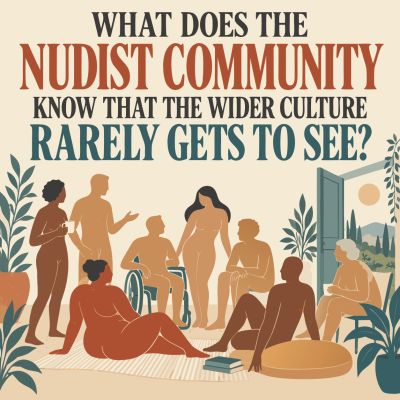
The nudist community has real evidence the wider culture rarely sees
Nudists routinely witness something culturally important: people with radically different bodies sharing space without collapsing into chaos, constant sexual activity, or universal judgment.
We know that wrinkles do not stop conversation. Scars do not ruin a swim. A soft stomach does not prevent laughter. Bodies can be visible without becoming invitations, threats, performances, or public property.
That knowledge has great value beyond the boundaries of the nudist community.
But I finally realized that I can not communicate its value effectively if I speak only about how wonderful nudism is.
People rarely go searching for an unfamiliar practice merely because its participants enjoy it. They search for relief from problems they already feel.
My task is to help them understand those problems more completely.
Compulsory concealment is not the sole cause of body shame, and social nudity is not its universal cure. But concealment deserves serious examination as one of the forces shaping how people understand their bodies. Social nudity deserves consideration as one possible corrective experience.
The sequence matters.
First, name the cage.
Then examine how it was built.
Only then does it make sense to show people that a door may be open—and that voluntary social nudity may be one way through it.