How We Lose Body Comfort
Most of us do not remember being taught to feel uncomfortable in our bodies.
There was rarely one lesson, one rule, or one moment when someone explained which bodies should be admired, which features should be hidden, or which changes should cause embarrassment. The messages accumulated—through words, images, reactions, expectations, and silences.
We noticed which bodies were praised and which became jokes. We learned that appearance could affect popularity, belonging, desirability, respect, and even how seriously someone was taken. We saw some body parts displayed to attract attention while those same parts were treated as indecent in ordinary life. We learned that being seen could invite judgment—and that concealment could become the price of social acceptance.
Eventually, lessons received from the outside could begin to sound like our own thoughts:
- I need to fix this.
- People will notice.
- I should cover that.
- My body is sending the wrong message.
- I cannot participate until I look different.
Body discomfort is not created by culture alone. Health, disability, trauma, discrimination, temperament, family relationships, gender, aging, and individual experience all matter. But no one develops a relationship with their body outside society. Culture helps determine what we notice, what we fear, what we compare, and what we believe a visible body means.

We Learn Which Bodies Supposedly Belong
Long before children can evaluate media critically, they begin absorbing patterns.
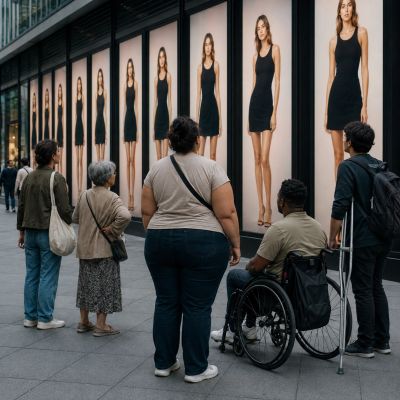
They see which bodies appear in advertisements, entertainment, toys, stories, and social media. They notice which people are presented as beautiful, successful, lovable, disciplined, healthy, comic, undesirable, or invisible. They hear casual remarks about weight, aging, skin, hair, disability, muscularity, development, and attractiveness.
No single comment has to declare, “Your body is unacceptable.” The hierarchy becomes visible through repetition.
When a narrow range of bodies receives most of the admiration, ordinary human variation can begin to look like failure. A person may come to believe that belonging is conditional—that the body must first become thinner, younger, smoother, stronger, more symmetrical, more conventionally masculine or feminine, or less visibly disabled.
The standard can change across time and culture, but the demand remains familiar:
Your body may participate fully only once it has earned approval.
Comparison Turns Other Bodies Into Measuring Devices
Human beings naturally notice differences. The problem begins when noticing becomes ranking—and when ranking becomes nearly continuous.
Mirrors once provided occasional reflections. Now photographs, video calls, fitness trackers, beauty filters, targeted advertising, and social platforms can keep appearance under inspection throughout the day. We compare our living, moving, changing bodies with images selected, posed, lit, filtered, altered, and sometimes generated precisely to command attention.
Even when we understand intellectually that an image is perfected, our emotional response may still treat it as evidence of what people are supposed to look like.
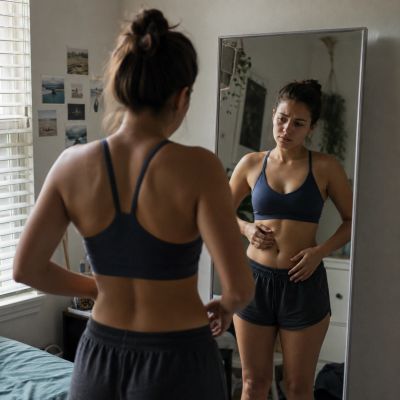
Comparison can change the experience of having a body. Swimming becomes an evaluation of the stomach. Dancing becomes a judgment about movement. A photograph becomes a search for defects. Aging becomes a succession of losses measured against a younger self.
The body stops being the place from which life is experienced and becomes an object monitored from the imagined viewpoint of everyone else.
Appearance Pressure Makes Acceptance Feel Irresponsible—or Financially Impossible
Many industries profit when ordinary bodies are interpreted as unfinished projects.
Some products and services genuinely improve health, comfort, expression, or enjoyment. The problem is not that people alter their appearance or want changes they cannot currently obtain. The problem is the constant production of dissatisfaction—the suggestion that normal skin needs correction, aging needs resistance, hair needs control, weight determines virtue, and confidence can be purchased if we keep improving the surface.
Under sustained appearance pressure, leaving a feature alone can feel like neglect. Acceptance may be mistaken for laziness, poor hygiene, lack of discipline, or “giving up.”
But maintaining a socially approved appearance also costs money.
Hair care, cosmetics, clothing, fitness programs, skin treatments, dental work, medical care, and procedures marketed as corrective can demand resources many people simply do not have. Even the time required for grooming, shopping, appointments, exercise, and recovery is distributed unequally.
Teeth make this inequality especially visible. A person may live with missing, damaged, discolored, or misaligned teeth—not because they do not care and not because they have freely chosen acceptance, but because dental care is unaffordable. Yet other people may still interpret their appearance as evidence of poor hygiene, irresponsibility, limited intelligence, or lack of professionalism. The person is judged for failing to purchase a correction that may cost thousands of dollars.
Similar pressures surround skin conditions, hair loss, scarring, disability, weight, aging, and access to well-fitting clothing. Wealth can purchase not only treatment but the appearance of health, youth, effort, and social conformity. Poverty and inadequate healthcare can become visible on the body—and then be mistaken for personal failure.
This creates a particularly cruel trap. People are taught that appearance affects whether they will be respected, employed, desired, photographed, or taken seriously. They may genuinely want a change, yet lack the money needed to make it. The resulting distress is not simply insecurity; it can be a rational response to a society that attaches real consequences to visible difference.
Body comfort should never be used to dismiss those consequences or tell people they should simply accept conditions they want treated. Nor should acceptance become society’s excuse for withholding affordable dental care, healthcare, adaptive support, or other needed services.
The deeper question is why dignity is made conditional on purchasing an approved appearance.
Personal grooming, fashion, fitness, treatment, and self-expression can be genuine pleasures. They become corrosive when choice is replaced by obligation, when care for the body becomes warfare against it, or when people are shamed for being unable to afford the body society expects them to present.
There is a difference between changing something because we want to, being unable to afford a change we genuinely desire, and believing we must purchase correction before we deserve to be seen and respected.

Shame Often Stops Calling Itself Shame
Many people do not identify with the word shame.
They may not consciously dislike their bodies or believe that anything is wrong with them. They may describe what they feel as modesty, embarrassment, self-consciousness, privacy, discomfort, decency, or simply knowing what is appropriate.
Those experiences are not all interchangeable with shame. Privacy can be deeply valued. Modesty can express personal or cultural identity. Discomfort may arise from trauma, unwanted attention, sensory needs, or a genuine preference not to be seen. We should not tell people that every boundary conceals a shame they are unwilling to admit.
But shame does not always announce itself by name.
It can operate as the expectation that being seen will be humiliating. It can appear as constant monitoring, strategic concealment, nervous humor, avoidance, or relief when an activity is canceled. It can be present when someone says, “I could never let anyone see that,” without ever thinking, “I am ashamed.”
Social judgment does not need to remain present once its rules have been internalized. The anticipated audience moves inside us. We begin predicting ridicule before anyone laughs, rejection before anyone speaks, and humiliation before anything happens.
This can make a learned restriction feel entirely personal:
No one is stopping me. I simply do not want to.
Sometimes that is exactly true—and the choice deserves protection. But sometimes the range of imaginable choices has already been narrowed by anticipated judgment. Avoidance brings immediate relief, and that relief can reinforce the belief that the avoided situation was unsafe, unbearable, or impossible.
A useful question is not, “Am I secretly ashamed?” That wording can feel accusatory and invite an automatic no.
More revealing questions may be:
- What do I imagine would happen if this part of me were seen?
- Whose judgment am I anticipating?
- Would I make the same choice if I knew no one would mock, reject, sexualize, or rank me?
- Does this boundary help me live according to my values, or does it prevent me from doing something I value?
- Am I protecting my privacy—or protecting myself from a humiliation I was taught to expect?
Shame is especially powerful when it disguises a social judgment as a personal fact. Weight becomes evidence of weak character. Aging becomes diminished worth. Disability becomes inadequacy. Visible anatomy becomes indecency. A learned emotional reaction begins to masquerade as proof that the body itself is the problem.
We do not need to label every discomfort as shame. But we should remain curious about discomfort that repeatedly reduces our choices, isolates us, or makes ordinary human characteristics feel discrediting.
Shame can shape a life even when a person would never use the word to describe what they feel.

Automatic Sexualization Changes What Visibility Means
Sexuality is a meaningful part of human life, but human anatomy is not sexual in every context.
Nakedness also exists in healthcare, caregiving, birth, breastfeeding, bathing, changing, art, education,. It can often exist in fitness, athletics, swimming, relaxation, social nudist traditions, ordinary family life, and simple physical presence. Context, conduct, intention, consent, and power matter.
Automatic sexualization collapses these distinctions. It treats the visibility of certain anatomy as inherently sexual, regardless of what anyone is doing or why the body is visible.
This creates a strange contradiction. Culture displays highly perfected and suggestive bodies to sell products, attract attention, and generate profit—while treating ordinary, non perfected bodies as shocking or inappropriate simply because they are less concealed,
The lesson is not merely that nakedness belongs only in private. It can become something more damaging:
If certain parts of your body are visible, you have introduced sexuality into the situation.
That belief transfers responsibility from conduct to anatomy. It can make people feel accountable for how others interpret their bodies, teach them that being seen is itself provocative, and confuse bodily existence with sexual invitation.
Sexual boundaries deserve protection. Consent deserves protection. Privacy deserves protection. None of those protections requires pretending that anatomy possesses a single meaning in every situation.

Compulsory Concealment Makes the Lessons Feel Natural
Clothing can provide warmth, protection, privacy, cultural belonging, self-expression, beauty, pleasure, and comfort. Choosing clothing is not evidence of shame, and choosing greater coverage does not make someone less body-comfortable,
Compulsory concealment is different.
It begins when concealment is no longer treated as one contextual choice among others, but as the condition that makes a body respectable. Certain anatomy must remain hidden because visibility is presumed to be humiliating, morally contaminating, dangerous, or inherently sexual.
The rule is reinforced so consistently that it can disappear from view. Concealment feels natural; visibility feels like a deliberate act. Clothing is treated as neutral, while the body underneath it is expected to justify its presence.
This can make it difficult to ask basic questions:
- Which boundaries protect a person’s autonomy, and which primarily protect a taboo?
- When does privacy support dignity, and when is privacy being used as a more acceptable word for shame?
- Why is a body considered neutral beneath fabric but disruptive when the fabric is removed?
- Can we respect someone’s decision to remain covered without teaching that being seen would make them indecent?
- Can different levels of bodily privacy coexist without one being treated as morally superior?
Examining compulsory concealment does not require compulsory exposure. Replacing one demand with its opposite would not produce freedom.
The goal is choice with enough understanding to make choice meaningful.

These Forces Reinforce One Another
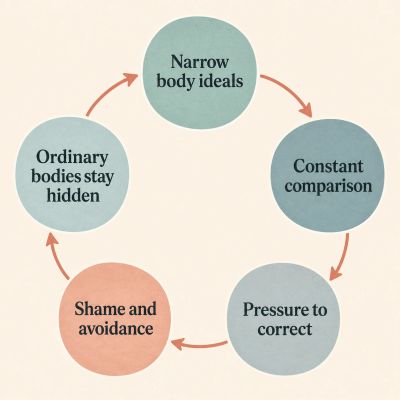
Cultural messages establish the standard. Comparison shows us where we supposedly fall short. Appearance pressure sells us possible correction. Shame warns us what may happen if correction fails. Automatic sexualization makes visibility feel charged or dangerous. Compulsory concealment then hides ordinary bodies from one another, leaving perfected and commercialized images to dominate what remains visible.
The cycle begins to confirm itself.
When ordinary bodies disappear, people have fewer opportunities to discover how broad ordinary human variation actually is. What is rarely seen begins to seem abnormal. What is always hidden begins to feel inherently private. What causes discomfort is assumed to be dangerous, and the discomfort itself is offered as proof that concealment is necessary.
This does not mean every boundary is false or every discomfort should be pushed through. It means discomfort cannot always be treated as unquestionable evidence. Sometimes it protects us. Sometimes it carries the imprint of trauma. And sometimes it is the emotional residue of a rule repeated so often that we have forgotten it was taught.
What Was Learned Can Be Examined
We did not personally invent all the meanings we carry about bodies. We inherited many of them before we were old enough to evaluate them.
That does not make us foolish or weak. It makes us human.
But inherited beliefs do not deserve permanent authority merely because they arrived early or became familiar. We can ask where they came from, what evidence supports them, whom they protect, whom they restrict, and what they cost.
We can distinguish health from appearance, privacy from shame, sexuality from anatomy, personal boundaries from universal rules, and chosen clothing from compulsory concealment.
We do not have to love our every feature. We do not have to become comfortable in every setting. We do not have to expose anything to prove that we have grown.
We can begin more simply: by noticing when an inherited judgment speaks with our voice—and deciding whether it still deserves to direct our lives.
Body comfort is not lost because the human body becomes unworthy. It is lost when we learn to experience the body through a tightening web of judgment, comparison, shame, and concealment. That web can be examined—and some of its threads can be loosened.