Why Is Nudity Humiliating?
The humiliation is not in the body. It is in what we have been taught bodily visibility means.
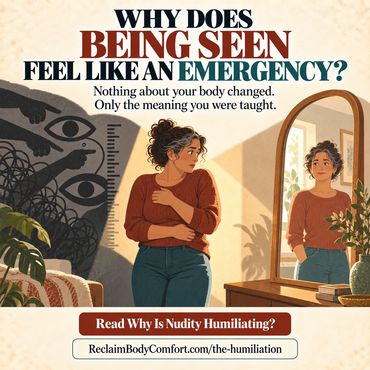
Imagine that a button comes undone at work. A towel slips in a locker room. Someone opens a bedroom door without knocking. Before there is time to think, the body reacts: the stomach drops, the face warms, the hands rush to cover.
Why?
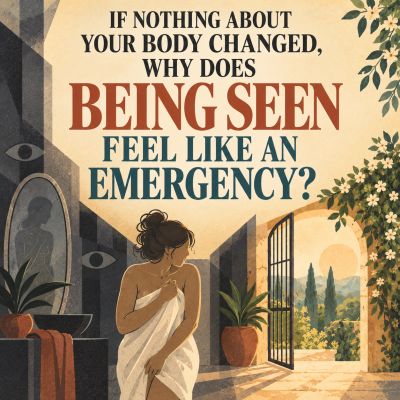
Nothing about the body changed in that instant. No body part suddenly became dangerous. Yet being seen can feel like a social emergency—as though something far more serious than skin has been exposed.
Nudity can feel humiliating because most of us have spent a lifetime learning that certain parts of the body must remain hidden. We learn that their visibility is improper, sexual, ridiculous, contaminating, or evidence that something has gone terribly wrong. We learn that other people are entitled to evaluate what they see. We learn that an ordinary body may fail an extraordinary test.
Then, when concealment fails or is taken from us, it can feel as though our dignity has been taken with it.
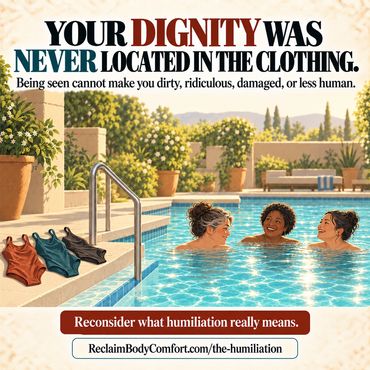
But dignity was never located in the clothing.
We are not born embarrassed by our bodies
A baby does not arrive knowing that one patch of skin is socially acceptable and another must never be seen. Young children do not naturally understand why a bare chest may be ordinary on one person and scandalous on another, or why a body that is acceptable in the bathtub becomes unacceptable several steps away.
They learn.
Some of that learning is necessary. Children need to understand privacy, consent, personal boundaries, appropriate settings, and protection from exploitation. Teaching a child, “You get to decide who touches your body,” helps build autonomy. Closing a bathroom door can be a healthy expression of privacy.
But those lessons often arrive carrying a second message:
Cover that up.
Nobody should see that.
That is dirty.
That is inappropriate.
You should be ashamed.
Adults do not always say the final sentence aloud. Children can hear it in a gasp, see it in a panicked expression, or feel it in the urgency with which a towel is wrapped around them. The lesson is communicated not only through rules, but through emotional weather.
Gradually, “This part of your body is private” can become “This part of your body is disgraceful.” Those are not the same lesson.
Privacy says, “I decide when, where, and by whom my body may be seen.” Shame says, “If my body is seen, something is wrong with me.”
One protects personal agency. The other places our worth under permanent threat.

What is hidden becomes heavily charged
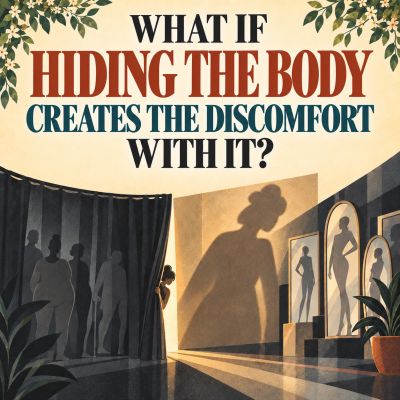
Compulsory concealment does more than keep certain anatomy out of sight. It gives that anatomy enormous symbolic weight.
When something must always be covered, its visibility begins to signal exceptional circumstances: sex, medical treatment, vulnerability, humiliation, or danger. Because ordinary nonsexual visibility is largely absent, people receive little evidence that a naked body can simply be a body.
This creates a cultural feedback loop:
- Bodies are concealed because their visibility is considered intensely meaningful.
- Because bodies are concealed, the rare moments when they are visible seem intensely meaningful.
- That apparent intensity is then used to justify even stricter concealment.
The body becomes trapped inside the meaning created around it.
This also distorts our understanding of what human bodies actually look like. The bodies most commonly displayed are selected, posed, edited, sexualized, or presented as problems to be corrected. Ordinary bodies—aging bodies, larger bodies, disabled bodies, scarred bodies and bodies altered by illness, pregnancy, surgery, or time—remain comparatively invisible.
So people are told to accept their bodies while being denied honest evidence of how varied bodies really are. They stand alone before a mirror and compare the most intimate, unedited version of themselves with images designed to survive casting calls, lighting crews, filters, and commercial selection.
Under those conditions, nudity can feel like appearing for an examination we were never prepared to pass.
Humiliation needs more than visibility
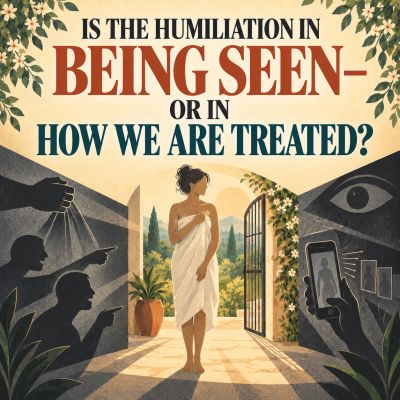
Nudity itself is not humiliation. Humiliation occurs when visibility is joined to degradation, powerlessness, or loss of social standing.
Being stripped by force can be humiliating. The humiliation comes from domination.
Having a private photograph distributed can be humiliating. The humiliation comes from betrayal and the theft of control.
Being mocked while changing can be humiliating. The humiliation comes from cruelty.
An unwanted sexual gaze can be humiliating. The humiliation comes from being treated as an object rather than a person.
In each case, culture often commits a revealing substitution: it locates the disgrace in the visible body instead of in the coercion, ridicule, exploitation, or contempt directed toward its owner.
A body part is not a behavior. Visibility is not consent. Nudity does not tell us whether a situation is respectful, abusive, sexual, ordinary, medical, artistic, private, or recreational. Conduct and context tell us that.
When choice is removed
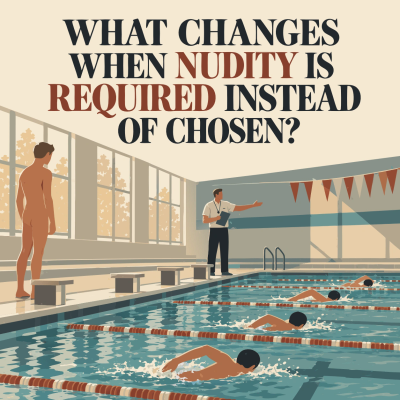
The history of mandatory nude swimming for boys in American schools makes this distinction especially clear.
For decades, boys in many schools were required to swim without suits. In Chicago, the practice reportedly continued in some schools into the late 1970s, long after improvements in filtration and swimwear had weakened the original hygiene rationale.
A WBEZ investigation recorded sharply different memories. Some former students said the practice did not bother them and a few remembered it fondly. Others described intense anxiety, mockery of bodies, bullying, unwanted inspections, and distress that followed them into adult locker rooms.
That history is sometimes treated as evidence about the effects of nudity. More precisely, it is evidence about compelled nudity inside a hierarchy.
These were adolescents. Teachers controlled participation. Students could not meaningfully decline. Classmates could exploit bodily differences. Resistance could be treated as weakness or used to question a boy’s masculinity or sexuality. Girls were allowed to wear suits, reinforcing a gendered double standard rather than establishing a genuinely body-neutral environment.
The schools did not remove shame from nudity. They removed choice from students who had already been taught to associate nudity with privacy and vulnerability.
There is a cruel contradiction in that arrangement: society taught boys that their genitals must remain hidden, ordered them to expose those genitals in front of their peers, and then suggested that a “real man” should not object.
Even a person raised with far less body shame might reasonably object to forced exposure. Consent is not merely a treatment for embarrassment. It is a principle in its own right. No theory of body acceptance gives another person or institution ownership of someone’s boundaries.
The answer to compulsory concealment is not compulsory exposure.
Why voluntary nudity can feel different
Remove the coercion, and the meaning can change.
In a respectful voluntary setting, a person decides whether to participate. The rules discourage staring, commentary, photography, sexual conduct, and harassment. People encounter bodies as varied and unedited rather than commercially selected. After the initial unfamiliarity, nudity may recede from the center of attention. People swim, talk, read, garden, eat lunch, or sit in the sun. Anatomy is present, but it is not the event.
Research on naturist activity is still limited and should not be exaggerated. However, psychologist Keon West found associations between naturist participation, more positive body image, higher self-esteem, and greater life satisfaction. His prospective studies also found immediate improvements following naturist events, although he appropriately noted limitations including self-selection, small samples in two studies, and the absence of randomized control groups. Intriguingly, seeing other people’s non-idealized bodies appeared more important than being seen oneself. A later experiment found that communal naked activity increased body appreciation, with reduced social physique anxiety as a possible mechanism. (West, 2018; West et al., 2021)
These findings do not prove that social nudity is necessary, appropriate for everyone, or a universal cure for body distress. They suggest something narrower and important: when nudity is voluntary, nonsexual, socially safe, and surrounded by ordinary bodies, it need not produce humiliation. Under some conditions, it may challenge the beliefs that make humiliation possible.

Reclaiming does not begin with taking off your clothes
For years, advocates of social nudity have sometimes started with the destination: Try it. You will feel free.
But a person who is frightened of bodily visibility may hear something very different: Do the exact thing your shame has taught you would be catastrophic.
That invitation may work for some people. For others, it places the cart before the horse.
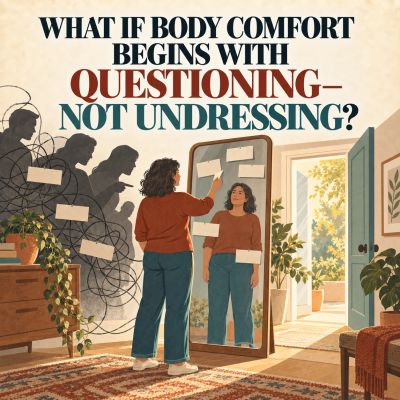
Reclaiming body comfort begins earlier. It begins by questioning the meanings we have attached to the body:
- Why does visibility seem to erase dignity?
- Who taught us that an ordinary body must earn the right to be seen?
- Why is anatomy treated as evidence of sexual intent?
- Why do we blame the exposed person more readily than the person who mocks, photographs, harasses, or exploits them?
- Can privacy be protected without teaching disgrace?
The purpose is not to make everyone want to be seen naked. It is to make bodily visibility less capable of destroying a person’s sense of worth.
How do we make nudity less humiliating?
We cannot erase a lifetime of conditioning with a slogan. But we can stop reinforcing it.
Teach privacy without disgust
Children can learn accurate names for anatomy, bodily autonomy, situational boundaries, and consent without being taught that their bodies are dirty or morally dangerous. But in a culture where “private parts” are already surrounded by alarm and embarrassment, simply saying “That is private” may leave shame to supply the explanation.
The healthier lesson needs to be explicit: “These parts are private because your body belongs to you—not because they are dirty, bad, or embarrassing. You deserve a say in when, where, and by whom your body is seen or touched.” Privacy should be taught as a right that protects the person, not as a warning that condemns the body.
Put responsibility on conduct
Mocking, staring, photographing, touching, exposing oneself to unwilling people, and using power to override another person’s choice are behaviors. Policies should identify and address those behaviors directly rather than treating the mere existence of anatomy as the original offense.
Stop using humiliation as protection
Fear can produce quick compliance, but it comes at a cost. Teaching someone that exposure would ruin them does not make them safer after a privacy violation. It gives an abuser greater power: the victim has been trained to believe that the stolen image or unwanted visibility has permanently damaged their worth.
Expand the visual definition of normal
People benefit from seeing a humane range of real bodies in appropriate, non-exploitative contexts. That can occur through art, health education, inclusive media, honest conversations, and—when freely chosen—body-neutral communal settings. The goal is not constant exposure. It is breaking the monopoly held by idealized and sexualized imagery.
Protect the right to choose
No one should be pressured to undress in order to prove confidence, maturity, liberation, masculinity, open-mindedness, or commitment to a cause. A reluctant yes extracted by social pressure is not the foundation of body comfort.
Let the pace belong to the person
Reclamation does not have to follow a gradual sequence. For some people it is incremental: looking at their body without conducting an inspection, swimming without a suit in genuine privacy, changing without rushing, refusing degrading body talk, or participating more fully in life before achieving perfect confidence.
For others, the willingness may take months or years to develop, but the change itself arrives with surprising speed. Someone finally chooses to enter a respectful social-nudity setting and discovers—sometimes within minutes—that people are not staring, ordinary bodies are everywhere, conversation continues, and the catastrophe they anticipated does not occur. What felt almost unimaginable beforehand can become remarkably ordinary once it is experienced.
The essential issue is therefore not whether reclamation happens slowly or quickly. It is whether the person controls the decision. A gradual process can still be coercive if every step is pressured, while a sudden experience can be liberating when it is freely chosen. Voluntary social nudity may be meaningful for some people, but it remains an invitation—not a test, treatment, or graduation requirement.

The body was never the disgrace
Nudity is feared because we have made it carry an extraordinary burden. It has been made to signify sex, danger, indecency, vulnerability, moral failure, and physical inadequacy—sometimes all at once.
When choice is removed, that burden becomes heavier. Forced exposure can turn the body into the site where power is exercised and dignity is attacked. But the wrong lies in the coercion, not in the skin it reveals.
Reclaiming body comfort means separating what culture has fused together:
Anatomy from behavior.
Visibility from consent.
Privacy from disgrace.
A person’s appearance from that person’s worth.
The goal is not a world in which everyone is comfortable being naked everywhere. It is a world in which nobody has to believe that being seen makes them dirty, ridiculous, damaged, or less human.
Nudity loses much of its power to humiliate when the body is understood as ordinary, boundaries are respected, and dignity is recognized as something no missing piece of fabric can remove.
That is what it means to reclaim body comfort: not compulsory exposure, not compulsory concealment, but meaningful choice without shame.

Like the Article? Help us Share it