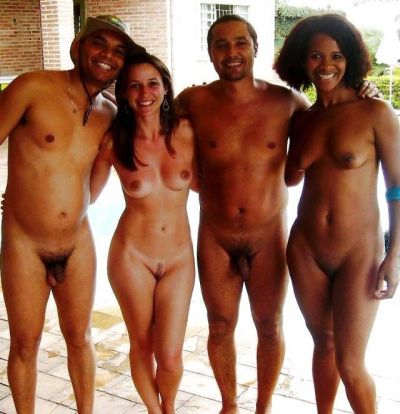
THE VULNERABILITY WHY FABRIC ISN'T PROTECTION

The Cold Knot in Your Stomach
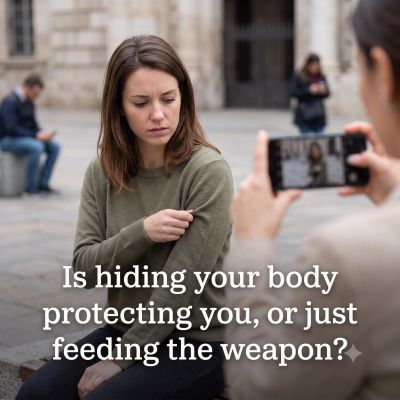
Have you ever felt that sudden, tight knot in your chest the moment a phone camera points your way?
It’s an almost instinctual reaction now. A quiet, exhausting flash of anxiety that forces you to adjust your stance, tug at your clothes, or scan the room to see who might be recording. In a matter of seconds, your focus shifts from living in the moment to managing an online image you never asked to project.
We’ve all been conditioned to carry this weight—living in a culture that treats our body like a volatile liability waiting to be caught, judged, clipped, or stripped and posted online. We have become especially vulnerable. And when modern technology—from instant social feeds to synthetic deepfakes designed to weaponize nudity—turns every lens into a threat, that background noise turns into a constant pressure cooker.
We were taught a simple rule growing up: If you just wear the right clothes, stay quiet, and hide enough of yourself, you’ll be safe.
But hiding our nakedness isn't keeping us safe anymore. It's just exhausting us.
The Weaponized Tribe
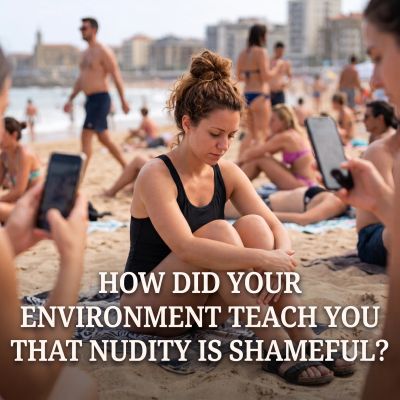
What we actually possess as human beings isn't an innate fear of our own naked bodies. It’s a profound sensitivity to social belonging and reputation.
We have an evolutionary drive to fit in with our tribe. For thousands of years, being cast out meant physical danger, so our minds are hardwired to protect our standing with the people around us.
The modern system didn't invent that deep need for acceptance—it hijacked it. It plugged in arbitrary, commercial rules about which parts of our biology are suddenly deemed "indecent" or "shameful," and then handed everyone with a smartphone the power to enforce those rules.
It tells us that human nudity is inherently scandalous, and then sells us thousands of products—from restrictive shapewear to synthetic swimsuits—just to buy back a fragile, temporary version of "decency."
When a culture agrees that simple nakedness is a high-voltage secret, it creates an endless supply of cheap leverage for bullies, bad actors, and invasive lenses. The fear of being "exposed" only works if we agree that our naked reality is something shameful to expose.
Stepping Out of the Trap
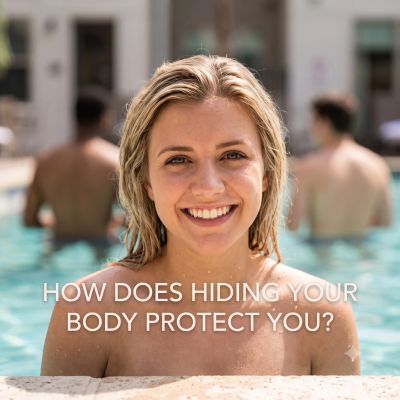
We don't fix a broken, hyper-vigilant culture by building higher walls, buying thicker fabric, or retreating further into the shadows. Hiding our bodies doesn't dismantle the lie; it validates it. Every time we apologize for existing in our natural form, we hand another piece of leverage over to the machine.
There is a much better way forward—a practical, quiet way to take the weapon right out of the bully’s hands.
It starts by recognizing that your worth isn't a performance to be managed, and human nudity is not a mistake that needs covering.
The Paper Doll Illusion
Look closely at modern swimwear. We are told it exists for modesty, decency, and social order. But step back for a moment and look at what’s actually happening on any public shoreline or pool deck.
Half of today's swimsuits are designed like neon highlighters. They are engineered by a multi-billion-dollar market using bold cuts and bright patterns specifically meant to draw maximum visual attention to the exact biology they claim to conceal.
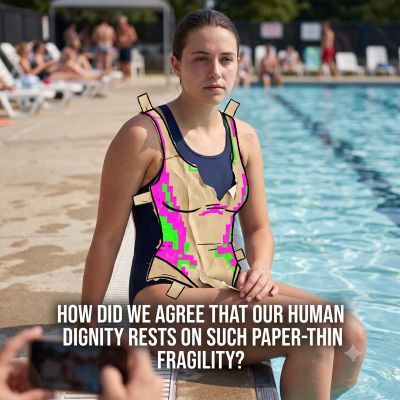
We’ve ended up with a strange social ritual: we force living, breathing human beings to strap tight, wet, synthetic compliance cutouts onto their skin just to touch water in public. It’s like a fragile paper doll swimsuit clipped onto a real person.
If you lose a clip, if the fabric slips, or if a camera catches an unapproved glimpse of nudity, the culture treats it as a disaster. Why? Because we’ve agreed to play a game where a tiny scrap of manufactured cloth is the only thing standing between human dignity and public humiliation.
This isn't an ancient, timeless truth about human nature—it’s a fairly recent, manufactured hangover. Even with string bikinis, we are still dragging around the heavy, anxious rules of Victorian England, an era so panicked by basic biology that they invented wooden "bathing machines" just to roll people into the ocean out of sight. We inherited their industrial-grade shame, swapped the wool suits for neon lycra, and forgot to ask why we were still playing the game.
Fabric doesn't purify our thoughts. The forced demand to cover our nakedness in places where it makes zero sense—like swimming and enjoying the sun on a beach—warps our thinking by creating an artificial, high-voltage mystery around basic biology.
The High Cost of the Secret
When society insists that human nakedness is a dangerous, volatile secret, it creates a massive black market for that secret.
This is why digital threats, non-consensual imagery, and AI deepfakes carry so much terrifying weight today. The threat doesn't come from technology itself; the technology is just a mirror. The real power comes from our collective agreement that being seen naked without manufactured armor is a life-altering disgrace.
- If nakedness is treated as a hidden treasure, it can be stolen and weaponized against you.
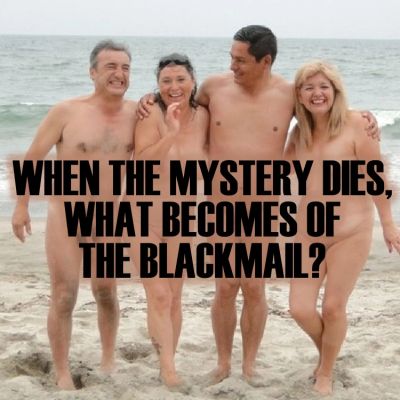
- If nakedness is treated as a scandalous secret, an algorithm can use it to blackmail you.
- If nakedness is treated as ordinary, natural, and unremarkable, the weapon shatters.
Hiding behind fabric leaves us open to continuous friction because it keeps the secret valuable. As long as we participate in the collective delusion that our natural bodies are inherently improper, we remain vulnerable to anyone holding a camera or generating an image.
Becoming SHAME PROOF
You cannot protect yourself from modern exposure by retreating into deeper hiding. The fences are gone, the cameras are everywhere, and digital deepfakes don't care how many layers of clothes you had on when you left the house.
Safety is not found in a thicker mask or a longer swimsuit. Safety is found when we stop treating our naked reality as an apology and become shame proof.
When we normalize human nudity and refuse to keep the secret, the leverage evaporates. You cannot blackmail someone with nakedness when natural bodies are seen as neutral, dignified, and completely ordinary.
(Want to understand how this personal journey started? Read "My Why" )
[ Discover The Shield → ]