Why This Matters
Why Should This Matter to You?
You may be reasonably comfortable with your body. You may have work to do, bills to pay, people to care for, hobbies you enjoy, and concerns that feel far more urgent than society’s relationship with nudity. You may already swim or socialize nude at a beach, club, resort, or private gathering and feel satisfied with the freedom available to you there. You may have no personal interest in social nudity at all.
In any of those cases, it is fair to ask why Reclaim Body Comfort should matter to you.
Reclaim Body Comfort does not assume that this issue occupies the center of everyone’s life. It does not ask everyone to become a naturist, attend a demonstration, abandon personal boundaries, or adopt the same degree of comfort with nudity. The more basic question is whether personal comfort is enough when fear and humiliation surrounding the human body continue to limit, exclude, and control other people.

You May Not Need This for Yourself
Some people experience body shame as a constant burden. Others have largely escaped it, learned to manage it, or found places where they can live with greater freedom. Still others may not describe their reactions as shame at all. They may call it discomfort, embarrassment, or disgust, or simply say, “That’s gross. I don’t want to see that.” Those reactions may be genuine, but naming them does not explain them.
Discomfort is not, by itself, a moral argument. It may instead be the beginning of a question: Why does an ordinary human body provoke that response, where did the response come from, and should it determine what other people are permitted to do? If you can enter a changing room without anxiety, seek medical care without feeling humiliated, appear in photographs without constant self-monitoring, or enjoy a beach or club where ordinary bodies are accepted, that freedom is real and valuable.
It should not be minimized.
At the same time, finding a way to live comfortably within the existing culture does not mean the larger cultural problem has been resolved. You may have found a refuge, developed confidence, or built a supportive community. Someone else may still be avoiding swimming, healthcare, intimacy, exercise, travel, or ordinary participation because of fear about how their body will be seen.
A freedom does not become unimportant because you have already found it for yourself.

Refuge Is Valuable, but It Is Not the Same as Cultural Freedom
Private clubs, resorts, homes, and designated beaches can provide important places of comfort and belonging. They allow people to experience what life can feel like when ordinary anatomy is not treated as a crisis. They can offer community, relief, and a temporary escape from the constant demand to monitor and conceal the body.
Those places matter, and we should never dismiss what they provide.
Yet a refuge does not exist outside the surrounding culture. A person may feel completely at ease behind a gate or on a designated beach while still living in a society where an exposed image can be treated as compromising, where accidental nudity can become public humiliation, and where visible anatomy can be confused with misconduct.
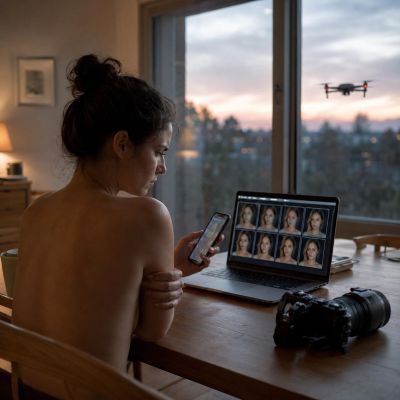
Modern technology has also made physical seclusion less reliable. Drones can pass overhead. Long-range cameras can cross boundaries. Smartphones can capture images without consent. Photographs can be copied, identified, altered, and distributed far beyond the place where they were taken.
The problem is not only that an image may be captured. The deeper problem is the cultural power attached to that image. A photograph becomes threatening because society has already decided that the visibility of an ordinary body may damage a person’s reputation, employment, relationships, or standing in the community.
Even people who have found places where nudity is accepted therefore have reason to care about how nudity is understood elsewhere.
Private refuge remains valuable, but it cannot provide complete protection from a culture that still treats the unclothed body as compromising evidence. Finding somewhere you can be free is not the same as living in a society that respects that freedom.

Body Shame Does Not Stay Confined to Nudity
It is too narrow to think of this as only a disagreement about where people should be allowed to remove their clothing. The beliefs surrounding nudity affect much more than nudity itself.
They shape how people experience swimming, changing rooms, healthcare, aging, disability, scars, weight, intimacy, photography, art, education, and public participation. They influence what children learn about their bodies before they are old enough to examine those lessons critically. They affect whether adults can speak plainly about anatomy and health, whether privacy is understood as a legitimate personal boundary or as protection from disgrace, and why an exposed, manipulated, or fabricated image can carry such enormous emotional power.
The deeper issue is not simply whether someone wants to be nude.
The issue is what happens when a culture gives ordinary human anatomy enough power to embarrass, threaten, discredit, or control a person.

The Freedom You Have May Be the Freedom Someone Else Needs
You may not avoid swimming because of your body, but someone else does. You may not postpone medical care because you fear being seen or examined, but someone else does. You may have found a community that accepts aging, larger, disabled, scarred, medically altered, or otherwise ordinary bodies, while someone else still believes they must change before they deserve to participate.
You may have enough confidence to believe that an exposed or fabricated image would not define your worth, while another person lives in fear that such an image could damage their relationships, career, reputation, or sense of dignity. You may also have money, transportation, privacy, or access to secluded places where body freedom is possible, while others have none of those advantages.
In many movements for social change, the people best positioned to help are not always those carrying the heaviest burden. They are often those with enough safety, confidence, experience, or support to speak when others cannot.
Your own relative comfort may place you in a better position to help make freedom safer and more available to others.
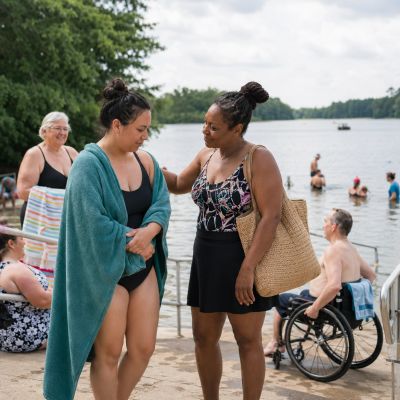
What Children Will Inherit
Every generation teaches the next one how to interpret the human body, often without giving a formal lesson.
Children notice what adults hide, ridicule, censor, whisper about, or treat as morally dangerous. They learn which parts of themselves can be discussed plainly and which must be surrounded by embarrassment. They observe whether bodies are treated as ordinary parts of human life or as sources of panic, shame, and suspicion.
They also learn from silence.
When adults cannot speak accurately about anatomy, privacy, consent, development, and bodily difference, children are left to gather meaning from jokes, pornography, peer pressure, advertising, secrecy, and fear.
Reducing body shame does not require removing privacy or abandoning age-appropriate boundaries. It means teaching truthful language without also teaching that the body is inherently contaminating, ridiculous, or disgraceful.
Even people who feel personally comfortable today have reason to care about the cultural inheritance being passed forward.

Technology Has Changed the Stakes
Body shame is old. The tools capable of exploiting it are increasingly powerful.
A camera can capture an unguarded moment. An image can be copied and distributed beyond anyone’s control. Drones and long-range lenses can reach into spaces that once felt secluded. Facial recognition can make anonymity harder to preserve. Artificial intelligence can create realistic scenes that never occurred or attach a person’s face to a fabricated nude body.
Privacy law, consent standards, platform accountability, and technological safeguards are essential. None of them is sufficient by itself.
The social weapon remains powerful because the culture has already agreed that the sight of someone’s ordinary anatomy can be catastrophic. That assumption gives a stolen, manipulated, or fabricated image much of its force.
A society with less body shame would not make privacy violations harmless. Violations of consent would still be wrong, and people would still have the right to control how their images are created and shared. What would change is the ability of such images to strip someone of dignity, credibility, or belonging.
That cultural defense is worth building before any one of us discovers that we need it personally.
Silence Preserves the Default
Most people do not consciously choose to perpetuate body shame. They simply live within inherited rules.
They wear what is required, avoid uncomfortable conversations, accept familiar jokes, remain silent when someone is humiliated, and assume that long-standing customs must have a sound reason behind them. This ordinary nonparticipation is understandable. People are busy, and speaking openly about bodies and nudity can carry social risk. No one can devote equal energy to every cultural problem.
Still, defaults survive because people continue organizing their lives around them. A belief does not need enthusiastic defenders when nearly everyone behaves as though it is inevitable.
Change begins when enough people become willing to ask whether an inherited discomfort is accurate, ethical, useful, or necessary.

Education Can Begin the Change
Getting involved does not have to begin with protest or public action.
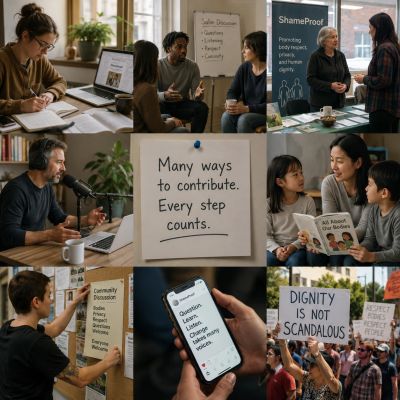
Cultural change can begin through questions, conversations, tabling, salons, reading groups, community gatherings, educational materials, podcasts, articles, social media posts, and discussions among friends and families. These quieter forms of engagement allow people to examine their reactions before feeling pressured to defend them. They create language for subjects that are often buried beneath nervous laughter, anger, or silence. There is very little nervous laughter about elbows. We need more ordinary conversations about those parts of the human body provoke that reaction, how they acquired that power, and whether the reaction is still useful.
It is possible that sustained education could eventually make some organized public actions unnecessary. Attitudes might shift far enough that people simply begin treating nonsexual nudity and nude swimming with less alarm.
That would be an excellent outcome.
It may not be the most likely outcome, however, because entrenched norms rarely disappear through discussion alone. At some point, people may also need opportunities to see that the peaceful, ordinary reality they have been taught to fear does not produce the predicted harm.
Education can prepare the ground. Visible examples may still be necessary to show what the discussion means in practice.

You Do Not Have to Do Everything
Participation does not require everyone to become an organizer.
You can begin by examining one assumption honestly. You can notice when anatomy is being confused with behavior. You can refuse to participate in someone else’s humiliation. You can speak more accurately about bodies around children. You can share a question or article, attend a salon, help at a community table, support educational work, or join carefully planned public action when the purpose is clear.
You can also challenge us when you believe an argument is weak, incomplete, or mistaken. A healthier culture will not be created by replacing one unquestioned doctrine with another.
Different people will contribute in different ways. Some will write, organize, research, make art, help privately, or speak publicly. Others may simply become one less person reinforcing unnecessary shame.
The work does not require identical choices. It requires enough people who are willing to stop treating the present culture as permanent.
Your Reason Can Be Your Own
Your reason for caring may come from personal experience. You may know what it feels like to lose part of your life to shame, or you may already have found a degree of body freedom and want others to have the same opportunity.
You may care about children receiving honest, age-appropriate education. You may care about privacy, consent, healthcare, digital manipulation, artistic freedom, public recreation, or the dignity of people whose bodies do not match narrow cultural ideals. You may care because you have seen someone humiliated, excluded, threatened, or diminished by the cultural meaning attached to their body.
You may simply believe that human beings should not be so easily controlled by the threat that their ordinary anatomy might be seen.
Your reason does not have to be identical to anyone else’s. It only has to be honest enough to begin.

Personal Comfort Is Not the End of the Story
You may not need to reclaim body comfort urgently for yourself. You may already have a good life, a supportive community, and places where you can experience your body with ease. You may never choose public nudity and never want to. Nothing here requires otherwise.
You may still decide that a culture with less fear, humiliation, and coercion surrounding the human body is worth helping to build.
You may decide that children deserve body truth without body panic, that privacy should be protected without treating anatomy as disgrace, and that conduct should be judged by consent, context, and harm rather than by the mere visibility of a body.
You may decide that the freedom you have found for yourself can become part of the freedom made available to others.
That can be your why.