The Shameproof Swim: A Long-Term Vision
What might become possible if natural human skin were treated as ordinary?
The Shameproof Swim is a long-term vision of a more body-comfortable culture. It is not an event that is currently taking place, nor is it an announcement that large public swims are ready to begin. It is a North Star: a picture of the kind of cultural change Reclaim Body Comfort hopes to help make possible over time.
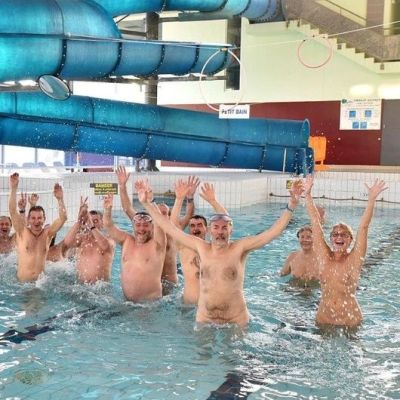
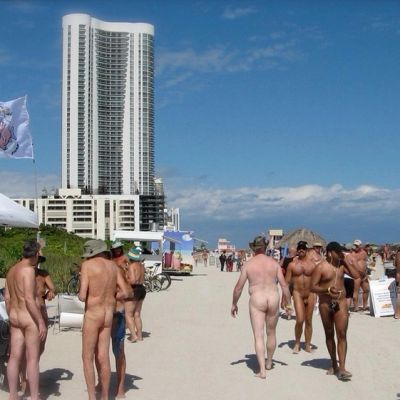
The vision is simple. Someday, ordinary people might be able to gather peacefully and swim without being required to cover parts of their bodies merely because those parts have been culturally designated as unacceptable to see. Such a gathering would not be organized as a spectacle, a provocation, or a sexual event. It would consist of neighbors participating in an ordinary human activity in a way that recognizes the body as natural, whole, and deserving of dignity.
That kind of swim would not be the beginning of the work. It would be the result of years of patient preparation. Before anything resembling a public Shameproof Swim could be responsible or practical, there would need to be public education, community conversations, relationship-building, legal research, local leadership, careful planning, and earned trust. The earlier stages might include educational tables, discussion salons, private gatherings, carefully bounded pilot events, public forums, workshops, articles, presentations, and partnerships with people and organizations that share a concern for dignity, consent, privacy, and body acceptance.
The need for that preparation is not merely logistical. For a public Shameproof Swim to communicate what it is intended to communicate, it would eventually require substantial participation from a visibly broad cross-section of ordinary people. Scale would help shift the meaning of the gathering from an unusual action by a small group into a credible demonstration that natural human bodies can be present in shared space without becoming sexual, threatening, or disorderly.
A small and inadequately prepared public action could produce the opposite effect. A handful of participants could easily be portrayed as exhibitionists, provocateurs, or members of an isolated subculture, regardless of their actual conduct or purpose. Instead of making ordinary nudity appear ordinary, such an action might reinforce the belief that it belongs only to the social margins. Smaller gatherings may still play an important role in education, trust-building, and practical learning, but they should be understood as steps toward the vision rather than attempts to stage the final vision prematurely.
Educational efforts need to come first and continue throughout the process. Tabling, salons, public discussions, articles, and smaller gatherings may help people reconsider assumptions about nudity, swimming, and public space. It is possible that cultural acceptance could grow far enough that a formally organized ShameProof Swim would no longer be necessary. That would be an excellent outcome.
But education alone is highly unlikely to overcome rules and customs that remain intact precisely because they are rarely tested in public. At some point, people may need to demonstrate—not merely argue—that peaceful, nonsexual nude swimming can occur without harm or disorder. A ShameProof Swim could provide that demonstration. Its purpose would not be spectacle for its own sake, but to make visible the ordinary public freedom being requested.
The Shameproof Swim represents where this work might eventually lead.
Why Swimming?
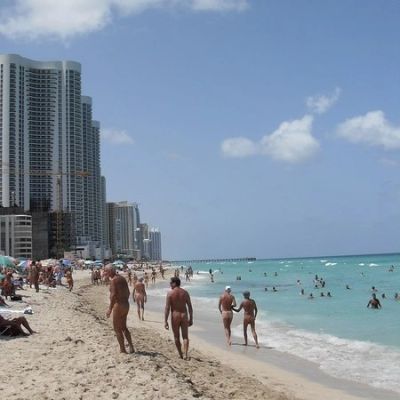
There are many ways to make a public statement. People can march, ride bicycles, hold signs, organize rallies, or gather for speeches. Swimming, however, is especially relevant to the questions Reclaim Body Comfort is asking because it exposes the cultural logic surrounding the body with unusual clarity.
Clothing serves many practical purposes in ordinary life. It can protect the body from weather, terrain, workplace hazards, insects, abrasion, or cold. It can provide pockets, decoration, identification, or personal comfort. In the water, however, most of those functions disappear. Ordinary clothing becomes heavy, restrictive, and inefficient. Even clothing designed specifically for swimming does not make swimming physically possible. Human beings are capable of swimming without it.
The swimsuit therefore performs a primarily social function. It does not enable the body to enter the water. It marks which parts of the body society permits to remain visible and which parts must be hidden before a person is considered acceptable in a shared space. A relatively small amount of fabric is treated as the difference between an ordinary swimmer and a person whose presence may be classified as indecent, alarming, or unlawful.
That contradiction makes swimming a particularly useful way to examine the assumptions surrounding the human body. It invites us to ask what practical problem the swimsuit is actually solving, why covering a few areas supposedly changes the meaning of the entire body, and whether the garment protects people from genuine harm or simply enforces a learned visual boundary.
Swimming also makes the physical effects of clothing unusually noticeable. Water surrounds the entire body. Wet fabric clings, compresses, shifts, and divides the body into covered and uncovered regions. It continually reminds the swimmer that the body is being managed according to a social rule. Swimming without that barrier can feel physically simpler and more coherent because the person experiences water, movement, sunlight, air, and skin without an artificial division imposed between different areas of the body.
None of this means that swimsuits or clothing are inherently bad. Clothing can be practical, playful, beautiful, and deeply expressive. The body is already a complete work of nature, but clothing allows us to add another layer of authorship. Through color, pattern, shape, and style, people can communicate personality, culture, mood, affiliation, and taste. At a beach or swimming pool, a swimsuit may therefore be worn simply because someone enjoys how it looks or how it helps them express themselves.
The more important question is whether the garment is being chosen or required. Is someone wearing a swimsuit because it pleases them, or because they have been taught that parts of their natural body become unacceptable the moment they enter a shared space? Would they still choose the garment if swimming without it were treated as equally ordinary and socially permissible?
A body-accepting culture would not require people to reject clothing. It would allow clothing to become what it can be at its best: an expression rather than a certificate of decency. People could enjoy the individuality that clothing offers without treating the uncovered body as unfinished, offensive, or morally suspect. The goal is not to replace one compulsory standard with another, but to make genuine choices possible.
For many people, swimming naked can create a rare sense of inhabiting the body as one undivided whole. That is why swimming matters to this vision. It turns an abstract cultural question into a direct physical experience.
What the Vision Represents
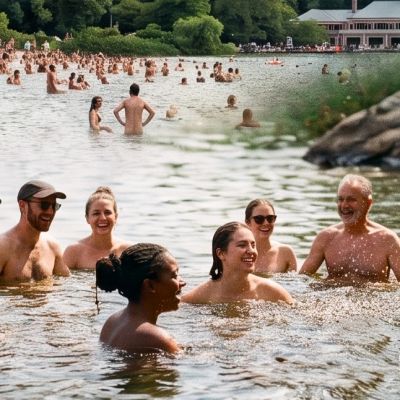
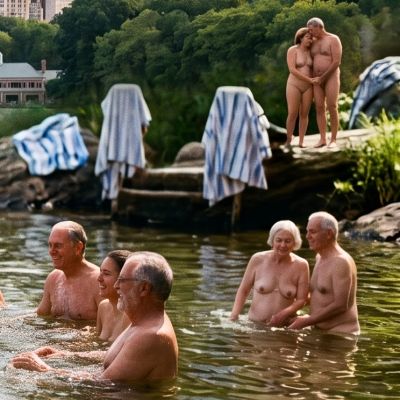
The Shameproof Swim represents the possibility of ordinary people developing a more peaceful relationship with their bodies. It imagines people of different ages, shapes, sizes, abilities, and backgrounds sharing the water without the body being treated as entertainment, evidence, invitation, or offense.
This vision does not depend on the belief that everyone should enjoy social nudity or participate in it. A more body-accepting culture would continue to respect privacy, clothing, personal boundaries, consent, and individual choice. The purpose is not to make exposure compulsory or to pressure people into situations they do not want. It is to make ordinary human anatomy less frightening, less sensationalized, and less useful as a tool of humiliation.
A person should be able to cover their body without believing that the body underneath is shameful. A person should also be able to experience their body without assuming that its visibility is automatically indecent. These are not opposing freedoms. They are different expressions of the same principle: the individual should have meaningful agency over how they inhabit and present their own body.
Why This Vision Matters Now
The need for greater body acceptance has become especially urgent in the digital age. Human bodies can now be photographed, copied, altered, distributed, and judged with extraordinary speed. Smartphones have placed cameras almost everywhere. Social platforms reward spectacle, outrage, ridicule, and emotional reaction. Images can be shared without permission, removed from context, or preserved indefinitely. Artificial intelligence can create convincing synthetic images of people in situations that never occurred.
These technologies did not create body shame, but they can exploit it with unprecedented efficiency. A manipulated, stolen, or nonconsensual image gains much of its destructive power from the cultural belief that being seen without clothing is uniquely catastrophic. The central wrong is the violation of consent, privacy, identity, and personal control, but the emotional damage is often intensified by a society that treats the unclothed body itself as evidence of disgrace.
Greater body acceptance would not make digital abuse harmless, nor would it excuse voyeurism, harassment, deepfakes, image-based abuse, or the distribution of private material. Those acts would remain serious violations. A more shameproof culture could, however, weaken one of the weapons such abuses rely upon: the assumption that the sight of a human body automatically destroys the dignity of the person shown.
Human dignity should not be stored in a piece of fabric. It should not disappear because an image has been stolen, altered, or fabricated, and it should not depend on whether strangers approve of a person’s shape, age, anatomy, or appearance. A person may be exposed, misrepresented, or treated cruelly, but their human worth remains intact. A shameproof culture would learn to place disgrace where it belongs: on the violation rather than on the body.

What a Shameproof Swim Would Require
A public Shameproof Swim would not need to wait until cultural and legal acceptance had already been achieved; its purpose could be to help move those conditions forward. Any such action would require careful planning and clear ethical standards. It would be peaceful, voluntary, nonsexual, and respectful of both participants and the surrounding community. It would not be designed to trap, embarrass, or shock anyone, but to make a visible case that ordinary human bodies and responsible public conduct can coexist.
Participants would be expected to respect personal space, avoid sexual comments or conduct, leave other people alone, follow applicable laws, and honor strict standards concerning consent. People who preferred to remain clothed would be entirely welcome, and no one would be pressured to remove clothing or participate in a way that made them uncomfortable.
The purpose would not be to demand that everyone immediately become comfortable with public nudity. Cultural change cannot be responsibly produced through coercion. The purpose would be to demonstrate that ordinary bodies and ordinary behavior can occupy the same space without automatically becoming sexual, chaotic, or threatening.
The swim would invite observers to consider whether the human body must always be treated as a problem. It would make that case primarily through ordinary conduct rather than confrontation. People would simply be swimming, talking, resting, and sharing public space while treating one another with the same boundaries and consideration expected in any community setting.
.jpg/:/rs=w:400,cg:true,m)
The Path Must Come Before the Swim
A North Star is valuable only when it helps determine the direction of present action. The immediate work is not to assemble hundreds of people at a beach. It is to build the understanding, language, relationships, and public trust that could make more visible cultural change possible in the future.
That work can begin with small, honest conversations about body discomfort, privacy, modesty, sexuality, fear, social conditioning, and the meanings people attach to nudity. Many people have never had an opportunity to examine these subjects without ridicule, pressure, or predetermined conclusions. Tabling, discussion salons and community gatherings could provide structured spaces in which people explore difficult questions without being required to agree.
Public education will also be essential. Tables at community events, printed materials, QR codes, talks, articles, exhibitions, videos, and online resources can introduce these questions in ways that encourage curiosity rather than defensiveness. Private and low-pressure gatherings may offer people lawful and consensual opportunities to experience greater body comfort within clearly defined boundaries.
Relationship-building will be equally important. A serious effort would need connections with civil-liberties advocates, educators, healthcare professionals, body-image organizations, artists, naturist groups, community leaders, and others concerned with dignity and human flourishing. These relationships would help the project avoid isolation, test its assumptions, understand community concerns, and develop stronger ethical and practical standards.
Legal and logistical research would need to proceed alongside cultural organizing—not to determine whether existing conditions grant permission, but to understand the conditions a ShameProof Swim would seek to challenge and change. Laws governing nudity, public spaces, demonstrations, permitting, disorderly conduct, photography, and expressive activity differ by jurisdiction and are often shaped as much by local enforcement practices as by statutory language. That research would help organizers choose a strategy, anticipate legal and practical risks, protect participants, and make informed decisions about whether an event would operate within existing law, test its boundaries, or openly challenge it.
Careful planning would also be necessary concerning accessibility, safety, transportation, communication, media, participant privacy, insurance, and the effect on nearby residents and visitors. These considerations would not be reasons to postpone action indefinitely. They would be part of organizing an action capable of advancing the cultural and legal change it seeks.
Cultural preparation may be the most difficult part of the process. Many people have been taught to treat nudity, sexual behavior, exhibitionism, vulnerability, and harm as though they were interchangeable. Reclaim Body Comfort would need to help people distinguish ordinary nakedness from harassment, coercion, deliberate sexual conduct, voyeurism, and exploitation. Those distinctions are essential to any credible body-acceptance movement.
These preliminary steps are not delays or distractions. They are the substance of the work. Without them, a public action could become little more than a dramatic gesture. With them, it could eventually represent a genuine change in how people understand bodies, consent, privacy, and shared space.

Why Not Demand It Immediately?
A strong moral conviction does not automatically produce a sound strategy. A poorly planned public swim could reinforce the very stereotypes Reclaim Body Comfort is trying to challenge. It might be interpreted as a spectacle rather than an educational act, expose participants to unnecessary legal or professional risks, frighten potential allies, and make future conversations more difficult.
Boldness and recklessness are not the same thing. A movement concerned with dignity should not disregard context, consent, or foreseeable consequences. It must be willing to question inherited rules while also understanding the social and legal environment in which those rules operate.
The Shameproof Swim should therefore remain ambitious without becoming careless. The vision can be clear even while the route toward it remains cautious, experimental, and open to revision. The goal is not to force an event into existence before the necessary foundation has been built. The goal is to create the conditions in which such an event might someday be peaceful, meaningful, and culturally constructive.

What the Shameproof Swim Asks Us to Imagine
The Shameproof Swim is about more than an unusual day at a beach or pool. It asks us to imagine a society in which the human body is not automatically interpreted as a sexual message, and clothing is understood as a useful and personal choice rather than proof of moral acceptability.
It imagines a culture that protects privacy without teaching people that their bodies are shameful. In such a culture, nonconsensual images would be condemned because consent was violated, not because the body itself was considered degrading. People could enter the water without feeling that their bodies had to be divided into acceptable and forbidden zones before they were permitted to participate. Neighbors could encounter physical difference without immediately transforming it into ridicule, disgust, fear, or sexual entitlement.
A large public swim may remain distant. It may take years of conversation, experimentation, research, coalition-building, setbacks, and cultural learning. That distance does not make the vision useless. A North Star does not prove that the destination has been reached. It provides a direction by which present choices can be evaluated.
Help Build the Path
The work begins by asking better questions and creating places where people can examine assumptions that are usually treated as unquestionable. Visitors can begin by reading and sharing the resources at Reclaim Body Comfort, hosting small conversations, participating in salons, helping with educational tables, and inviting others to explore why human bodies are treated so differently from every other part of the natural world.
The project also needs thoughtful criticism. People can contribute by identifying ethical concerns, practical barriers, legal questions, communication problems, and unintended consequences. A durable movement will require more than agreement. It will require people who are willing to challenge weak reasoning, refine the vision, and help build methods that deserve public trust.
The Shameproof Swim is not here yet. It is a picture of what might eventually become possible if enough people help create a culture in which human dignity is stronger than body shame.
That is the direction in which Reclaim Body Comfort is moving.