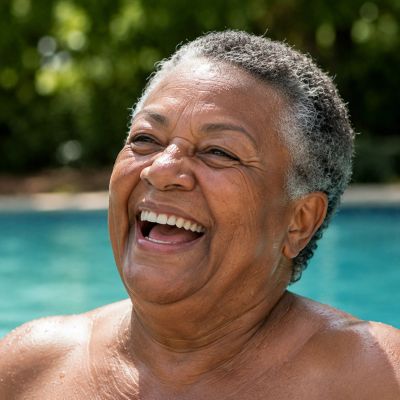
Can you remember feeling—or imagine being—this comfortable and joyful in your body? Before comparison took over and perfection became the measure, your body was simply how you experienced life—water, sunlight, air, movement, and so much more.
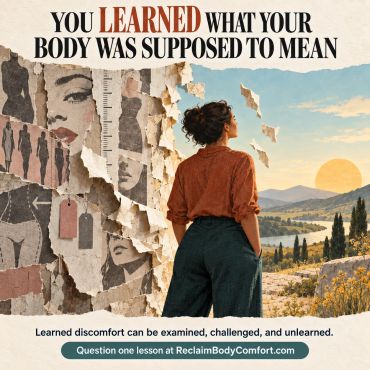
We are not born measuring ourselves against perfected images or believing that ordinary bodies are shameful. Over time, we learn what bodies are supposed to look like, what they supposedly mean, when they must be hidden, and how harshly they should be judged.
But learned discomfort is not beyond question. Reclaiming body comfort means examining those lessons, seeing our bodies more truthfully, and deciding for ourselves which beliefs still deserve authority over us.

What Is Body Comfort?
Body comfort is not believing that your body is perfect. It is the freedom to live in your body without constantly monitoring, correcting, comparing, concealing, or apologizing for it.
It can mean swimming without spending the afternoon thinking about your stomach. Going to the doctor without feeling humiliated by being examined. It means fully participating in life rather than letting not meeting some imagined standard stop you. It’s recognizing that an ordinary human body does not become indecent simply because it is visible.
Body comfort does not require loving every feature or abandoning every insecurity. It means those feelings no longer have unquestioned control over where you go, what you do, or how fully you participate.
What might become possible if your body did not have to earn the right to belong?
Discomfort Is Not Created in a Vacuum
A child does not begin life with a list of acceptable body shapes, forbidden features, embarrassing changes, or anatomical parts that supposedly determine a person’s character.
Those meanings accumulate.
They arrive through advertising, entertainment, teasing, family reactions, religious and cultural messages, dress codes, pornography, perfected images, and the quiet observation of which bodies are admired, mocked, hidden, sexualized, or treated as problems.
Body-image research does not suggest that culture explains every person’s experience. Temperament, health, trauma, family relationships, discrimination, and many other factors matter. But substantial research does show that appearance ideals, comparison, objectification, and social feedback can shape how people evaluate and experience living in their bodies.
If discomfort can be learned and reinforced, some of it can also be examined, challenged, and unlearned.

Why Examine Compulsory Concealment?
Clothing serves many valuable purposes. It provides warmth, protection, self-expression, cultural belonging, privacy, and pleasure. Reclaim Body Comfort is not a campaign against clothing.
The question is not whether people should wear clothes. The question is what we are taught to believe about the body underneath them.
Compulsory concealment describes more than choosing privacy or dressing for a particular situation. It is the expectation that certain parts of the human body must always be hidden because their visibility is presumed to be inherently humiliating, shameful, indecent, dangerous, or sexual.
Examining that expectation does not mean rejecting every boundary. It means asking where our boundaries came from, what they accomplish, and whether concealment around other people is always necessary to maintain respect.
Can privacy be protected without teaching people that their bodies are disgraceful?

Anatomy Is Not Behaviour
Bodies can be involved in sexuality, but bodies are not always sexual.
A breast can feed a child. Genitals can be washed, examined, treated, changed, injured, aged, or simply present. Nakedness can occur during caregiving, medical treatment, changing clothes, bathing, swimming, art, family life, emergencies, or chosen social experiences.
None of these situations becomes sexual merely because anatomy is visible.
Respectful behaviour depends on actions, consent, context, boundaries, and power—not on the automatic moral meaning assigned to a body part.
That distinction matters. When anatomy and behaviour are treated as though they are the same thing, ordinary bodies can become objects of fear while genuinely harmful conduct receives less precise attention.
A body can be visible without being available. Privacy can be valued without making anatomy shameful. Consent remains essential whether people are clothed or unclothed.
Choice Deserves Protection. Beliefs Deserve Examination.
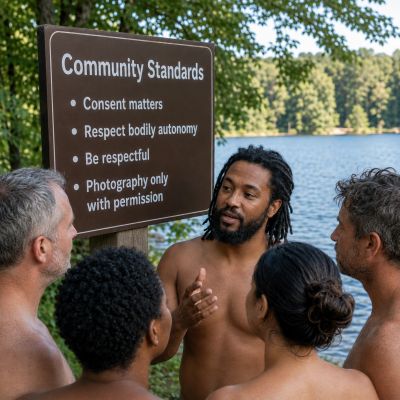
Reclaiming body comfort does not require public nakedness, social nudity, revealing clothing, or comfort with every situation. No one should be pressured to expose their body, disregard their boundaries, or demonstrate body acceptance in a particular way.
But respecting a person’s right to choose is not the same as treating every belief behind that choice as unquestionably healthy, natural, or harmless.
Our ideas about modesty, privacy, and exposure came from somewhere. They may reflect practical needs, personal preferences, cultural belonging, religious teachings, traumatic experiences, fear of judgment, learned shame—or some combination of these. A boundary can deserve protection even while the forces that shaped it deserve careful examination.
The human body is not an exotic or inherently threatening object. Its basic anatomy is shared across humanity. When ordinary body parts are treated as shocking, indecent, dangerous, or morally contaminating, we should be willing to ask why—and what those beliefs cost us.
The goal is not to replace compulsory concealment with compulsory exposure. It is to protect people’s bodily autonomy while questioning the conditioning that can make concealment feel mandatory and visibility feel unthinkable.
We can honor a person’s boundary without granting every belief behind it permanent authority.

Why This Matters in Ordinary Life
Body discomfort rarely stays confined to the mirror.
It can influence whether someone swims, dances, seeks medical care, tries a new relationship, changes in a shared room, appears in photographs, enjoys physical affection, or participates in activities they value.
It can make puberty feel like contamination, aging feel like failure, disability feel like exclusion, and natural bodily variation feel like evidence that something has gone wrong.
Reclaiming body comfort will not erase every insecurity or remove every social pressure. It can, however, help us recognize when learned judgments are shrinking our lives—and give us more authority over what happens next.

ShameProof: The Sharper Question
Reclaim Body Comfort begins with a broad human concern: How can we develop kinder, more truthful, and less restrictive relationships with our bodies? That requires examining a more foundational question: What does compulsory concealment in social settings teach us about our bodies—and what effects do those lessons have?
This work originally began with questions about nakedness and the shame attached to it. As it developed, an important distinction became clear: nakedness and compulsory concealment are closely related, but they are not the same subject.
Before we can understand why nakedness carries so much emotional and social weight, we need to examine the expectation that certain parts of every ordinary human body must remain hidden—and the meanings we learn to attach to them because they are hidden.
The ShameProof section takes that inquiry further. It examines the exaggerated meanings attached to nakedness, the automatic sexualization of anatomy, and the assumption that concealment is always necessary for dignity, morality, or safety.
It asks difficult questions without dismissing consent, privacy, trauma, or legitimate protection. Its purpose is not to make people less careful. It is to help us distinguish more clearly between a body, a boundary, and a harmful act.

Explore More Deeply
A homepage can open a door. Meaningful change usually requires more time.
The Reclaim Body Comfort learning community offers a place to explore these ideas through:
- focused lessons and complete articles;
- research and competing interpretations;
- videos and audio discussions;
- reflection questions and practical exercises;
- thoughtful conversations with other members;
- the expanded ShameProof archive;
- evolving salons, projects, and community events.
You do not need to agree with every idea to participate. You need only a willingness to examine what you have been taught, consider evidence, and treat other people’s experiences with respect.
Explore the Learning Community (Coming soon)

What Would You Like to Reclaim?
Perhaps it is the freedom to swim with nothing between you and the water.
To appear in photographs without hiding from the record of your own life.
To seek medical care without humiliation.
To age without treating every change as defeat.
To stop measuring your worth against a manufactured image.
To feel sunlight, water, air, movement, affection, and life without constantly watching yourself from the outside.
You do not have to become fearless, perfectly confident, or endlessly positive about your body.
You can begin by questioning one lesson that no longer deserves authority over you. and exploring how we lose body comfort.

Like the Article? Help us Share it
.png/:/rs=w:370,cg:true,m)